Why Repeated Shapes Make a Planting Border Feel Connected
Repeated shapes in a planting border create rhythm without making every plant alike. Learn to choose suitable forms, pair plants and keep the pattern clear.
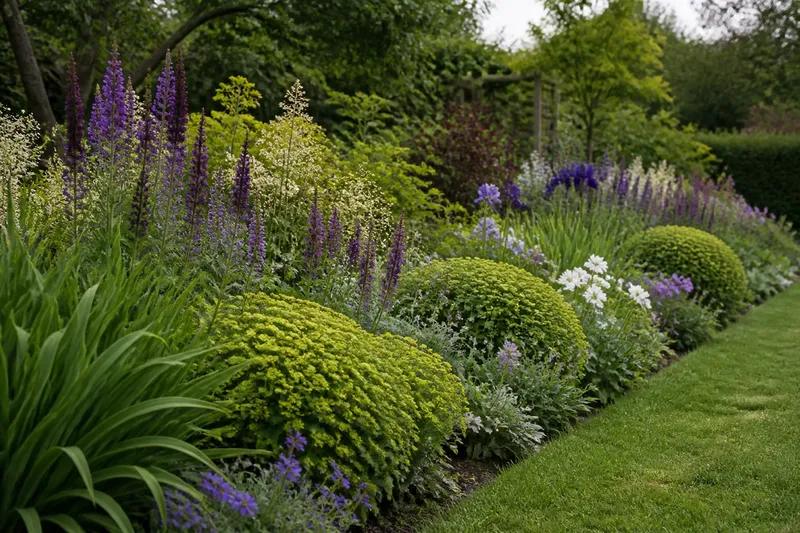
Repeated shapes in a planting border can link different plants without making the bed look like a row of copies. Choose forms that suit the growing conditions, then repeat them through foliage and habit rather than relying only on flowers.
Choose plant shapes that suit the site
Begin with the outline of a plant: an upright clump, a rounded mound, a broad leafy dome or a fine, branching spray. These forms are easier to recognise than subtle differences in flower colour, especially when viewed across a planted bed.
Match each form to its position before you plan repetitions. Check the plant label or a reliable supplier’s guidance for light, soil and mature habit; a shape that works in a sunny border may not suit a shaded patch.
For instance, imagine a bed with a sunny section and a partly shaded end. If a sun-loving plant creates the rounded outline you want, choose a shade-suitable plant with a similar habit for the darker end; the expected result is a repeated low form without asking one species to thrive in both places.
Repeat a recognisable habit across different plants
Repeating one species makes a clear motif, but it is not the only option. Different plants can share an obvious habit, such as upright flower spikes or rounded cushions, while differing in foliage, flowering season and colour.
Keep the shared feature visible beyond the flowering period. If the resemblance depends on a brief display of blooms, the link may disappear once they fade. Foliage and stems often provide a steadier outline, though some plants lose their form when cut back.
This approach is useful when the border contains varied conditions. Choose plants for each position first, then connect suitable choices through a similar silhouette.
Place repeated forms in loose groups
Arrange the recurring shapes so the eye can pick them up along the planting, but avoid making every group identical or evenly spaced. A repeated mound can appear beside an upright clump in one place and partly behind foliage elsewhere.
Leave enough space for each plant’s mature habit. Crowded forms merge, while plants set too far apart may not read as part of the same pattern. Use labels and supplier guidance to judge likely spread, then adjust the layout to the bed and neighbouring plants.
Try a simple paper plan before planting: mark the plants that share a shape, then check whether those marks recur without forming a rigid line. If they do, vary a group’s position or the plants around it.
Use foliage contrast to keep the pattern clear
Repeated forms need contrasting neighbours to remain legible. Set a rounded mound against narrow leaves, or place an upright clump beside a looser, spreading plant. Contrasts in leaf size, texture or colour can also separate shapes that might otherwise blend.
Use contrast selectively. If every neighbouring plant has a different outline and texture, the repeated forms lose their role as links. Where two similar plants merge, move one group or place a plant with a clearer silhouette between them.
Keep the shape legible as flowers fade
Consider what remains when the blooms finish. A plant with useful foliage or standing stems can preserve the pattern, while one that is cut back may leave an empty space. Pair plants with different flowering seasons only when their foliage or habit also helps maintain continuity.
Before planting, check whether the plants need division, cutting back or other routine care to keep their natural outline. Let the plants retain their individual character; the aim is a recurring form, not matching silhouettes.
How should repeated shapes work in a planting border?
How many shapes should I repeat?
Start with a few distinct forms, such as upright, rounded and airy. Add another only if it has a clear role, so the planting does not become a collection of competing outlines.
Do repeated plants need the same flower colour?
No. Similar outlines can connect plants with different flower colours, particularly when their foliage or habit also relates. Keep the shared shape easy to recognise if the colours vary.
Can I repeat shapes in a narrow border?
Yes. Repeat one or two forms and leave room for their mature spread; too many layered outlines in a shallow bed can hide one another.
What if one plant grows differently from the others?
Allow for natural variation rather than trying to make every plant match. If a plant consistently overwhelms its neighbours, consider moving it, dividing it when suitable, or choosing a better fit for that position.
Check the planting plan before you put plants in
- Check whether each plant’s light needs match its position; if they do, keep it there, and if they do not, move it to a more suitable spot or choose another plant.
- Check the soil guidance for each plant; if the conditions suit it, include it, and if they do not, select a plant suited to that soil.
- Check the expected mature spread on the label or supplier guidance; if neighbouring forms have room, plant them as planned, and if they will crowd, increase their spacing or reduce the group.
- Check whether the repeated outline remains visible after flowering; if foliage or stems preserve it, use the plant as a link, and if the form disappears, pair it with a more persistent shape.
- Check whether adjacent plants contrast in leaf shape or texture; if the repeated form stands out, keep the pairing, and if the outlines merge, reposition a plant or add a clearer contrast.
- Check whether the marked repetitions form a rigid line on the plan; if the pattern feels loose, keep the arrangement, and if it looks mechanical, stagger a group or vary the gaps.
Imagine you have marked three rounded plants on a paper plan, but one sits in shade where the chosen species needs sun. First, check the plant guidance and confirm that the other two positions are suitable. Next, replace the shaded choice with a shade-tolerant plant that has a similar rounded habit, then shift the marks so they form a loose group rather than an even row. The resulting decision is to retain the repeated shape while changing the species and spacing; the expected result is a pattern that fits the site and stays visually connected.
Use repeated shapes in a planting border as a quiet organising device: choose forms suited to their conditions, vary the plants around them and leave room for mature growth. Recheck the pattern as plants establish, and move a group if its outline becomes hidden by its neighbours.