Straight Path or Gentle Curve: Two Ways Through a Garden
Compare a straight path or gentle curve for your garden, then choose a comfortable route that reaches its destination and leaves useful space for planting.
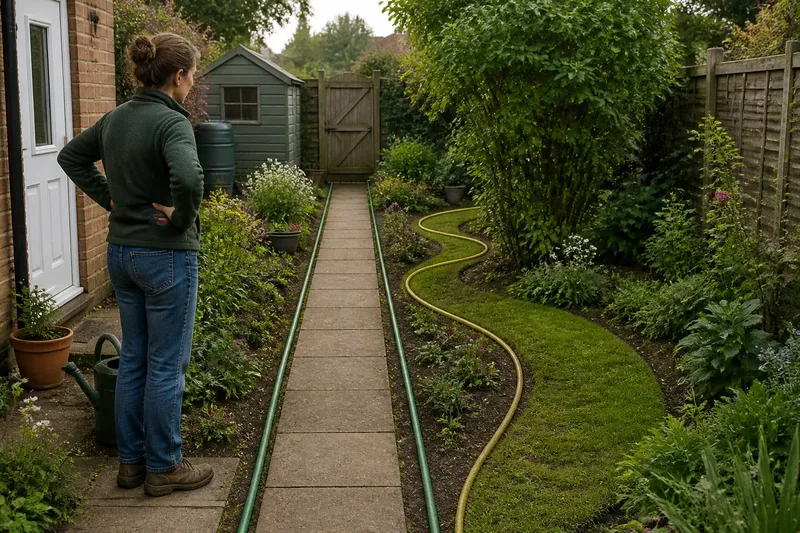
A straight path or gentle curve should be chosen for the job it needs to do, not just for the line it draws on a plan. Mark both options with a garden hose before digging, so you can compare access, usable planting space and how easily the route reaches its destination.
A straight garden path keeps access direct
A straight path connects two points clearly, which suits a route between a back door and a gate, shed or greenhouse. It can also help organise a narrow garden, where a bend would use ground needed for beds or access.
The trade-off is that a straight line can divide the garden or draw attention to whatever sits at its end. If the route runs through the centre, check whether the beds on either side would be left too narrow for the plants and maintenance you have in mind.
Mark a proposed line with rope and stand at its starting point. If it leads towards a blank fence or an awkward service area, consider shifting it to one side or adding a useful feature at the end.
A gentle curve can work around features
A gentle curve can pass around an established tree, a patio edge or a planted bed without forcing the rest of the layout into rigid lines. It may also make a broad space feel less exposed, provided the change of direction has a clear purpose.
Curves create uneven planting space: a bed may widen on the outside of a bend and narrow on the inside. Use the wider section for plants that need room, and make sure the narrow section remains accessible for edging and weeding.
Keep the turn broad enough to walk comfortably and carry a watering can or wheelbarrow. Mark the arc, walk it at a normal pace and adjust it if you have to shorten your stride or swing wide to get around the bend.
Compare routes by their practical footprint
The best shape is the one that leaves useful ground around it. A straight path may be more space-efficient in a narrow garden, while a curve can fit a wider plot if it avoids an obstacle or gives a bed a workable outline.
Check the route against your actual needs: access to doors and gates, room to move garden tools, and space to reach the planting beside the path. A line that looks graceful but leaves an awkward strip for maintenance may be a poor fit.
Say you have a narrow garden with a back door at one end, a gate at the other and a mature shrub near the left boundary. Mark a straight route along the right side, then a second route that bends around the shrub; walk both while carrying a watering can and check the remaining bed space. If the direct route leaves a broad, reachable bed and clears the shrub, choose it; if it crowds the planting or clips the shrub’s spread, use the broader bend and accept that the route takes longer.
Decide how direct the destination should be
Use a direct route for places you visit often or reach while carrying bulky items, such as a bin store or greenhouse. A longer curve can be tiring on a routine trip, even if it makes the garden feel less formal.
A path can arrive at a functional destination rather than a focal point. Make the last few paces easy to follow, and avoid a sudden sideways turn where the path meets a gate, step or patio.
If the path ends at a seating area, make sure the approach still leaves room to enter and leave without stepping into a border. Mark the connection as well as the main route.
Which path shape suits your garden?
Is a straight path better for a narrow garden?
Often, because a direct line can leave more room for planting than a bend. If the route divides a narrow plot into strips that are difficult to reach, move it towards one side or consider a curve only where it avoids a real obstacle.
When does a curved path make sense?
Use a curve when it goes around a feature, gives a bed a useful shape or creates a more comfortable approach to a destination. If it has no practical job, simplify the route instead of adding a bend for its own sake.
How can I check a route before building?
Lay out the line with a hose or rope and walk it in both directions, including while carrying something you commonly take through the garden. Check that entrances are easy to reach and that the planting beside the route remains accessible.
Can a path combine straight and curved sections?
Yes, when each section has a clear purpose, such as a direct approach from a door followed by a bend around a tree. Keep the transition easy to follow and remove any small turns that do not improve access or make room for a feature.
Check the route before choosing materials
Once the line works, choose a surface that suits its shape and use. Brick, paving slabs and compacted gravel have different appearances and installation needs; joints and edges can make a curve look neat or awkward, especially where small cut pieces are required.
For a straight route, aligned joints can reinforce the direction of travel. Smaller units may be easier to arrange along a curve, while larger slabs need careful planning to avoid distracting slivers at the edges.
Think about footing, drainage, maintenance and how the material sits beside the house and planting. Follow the maker’s instructions and check local requirements where relevant before installing it.
Use a simple route check before committing
- Check whether the line connects the doors, gates or working areas you actually use; if it misses one, move the start or end point, otherwise keep the connection.
- Check whether a straight route points towards an unwanted view; if it does, shift the alignment or add a useful focal feature, otherwise retain the direct line.
- Check whether a bend goes around a tree, bed or structure; if it does not, straighten it, otherwise keep the curve and confirm it leaves enough room to pass.
- Check whether the route leaves beds wide and reachable enough for their planned planting; if it does not, move the path or reduce the planting area, otherwise keep the layout.
- Check whether you can walk the marked route carrying a watering can or garden tool; if a turn feels tight, widen or soften it, otherwise keep the marked arc.
- Check whether the path reaches a gate, step or patio without a sharp final turn; if it does not, adjust the approach, otherwise proceed to surface planning.
- Check whether the proposed material can follow the route without awkward edge cuts; if it cannot, choose smaller units or a more suitable surface, otherwise plan the edging and joints.
A straight path or gentle curve works when its shape supports access and leaves the rest of the garden usable. Mark the route, walk it, check the planting space and make one final adjustment before you fix the edges in place.